
India's industrial production growth decelerated to an 8-month low of 2.4 per cent in November, mainly due to poor showing by the manufacturing sector, according to the official data released on Friday. The factory output growth measured in terms of the Index of Industrial Production (IIP) was 7.6 per cent in November 2022. The previous low of IIP growth was recorded at 1.9 per cent growth in March 2023.

India's industrial production growth decelerated to a six-month low of 2.9 per cent in February 2025, mainly due to poor performance of the manufacturing, mining and power sectors, according to official data released on Friday. The government also revised upward the industrial growth figure to 5.2 per cent for January 2025 from the provisional estimate of 5 per cent released in March.
The country's industrial production grew at 4 per cent in August, mainly due to better performance by the mining sector, according to government data released on Monday.

India's annual industrial output growth slowed to 4.2 per cent in July compared with an upwardly revised 4.4 per cent growth a month ago, government data showed on Friday.

The output of eight key infrastructure sectors expanded by 2 per cent in September, though the growth was slower than the 9.5 per cent registered in the same month last year, according to official data released on Wednesday. The output of these sectors had contracted by 1.6 per cent in August. Out of the eight key sectors, three -- crude oil, natural gas and electricity -- recorded negative growth in September.

The production growth of eight key infrastructure sectors slowed to a six-month low of 7.8 per cent in November due to a decline in the output of crude oil and cement sectors. The growth rate in the production of coal, fertiliser, steel, and electricity also decreased during November this year. According to the data released by the government on Friday, the growth during the month under review, however, is higher than the 5.7 per cent recorded a year ago.

The country's industrial output growth trickled to 6.2 per cent in October, the lowest this fiscal, on account of a slowdown in manufacturing production.
The IIP growth was 0.6 per cent as against 1.7 per cent in April last year.

India's industrial production slowed to a five-month low of 4.2 per cent in June 2024, mainly due to poor performance of the manufacturing sector, though power and mining sectors continue to perform well, as per official data released on Monday. The factory output growth, measured in terms of the Index of Industrial Production (IIP), was 6.2 per cent in May, 5 per cent in April, 5.5 per cent in March, 5.6 per cent in February and 4.2 per cent in January 2024.

'Healthy double-digit returns are still possible, though a sharp rally is unlikely.'
The eight core industries -- fertilisers, cement, steel, electricity, crude oil, coal, petroleum refinery products and natural gas -- have a combined weight of about 38 per cent in the Index of Industrial Production.
India's manufacturing sector activity reached a three-month high in May, with the HSBC India Manufacturing Purchasing Managers' Index (PMI) rising to 55.0, driven by robust domestic demand, infrastructure projects, and new business gains despite ongoing inflationary pressures.
Decline in production of crude oil coupled with a slowdown in output of other products pulled back the growth of six key infrastructure industries to 5.3 per cent in June compared to 7.7 per cent a year ago.

The growth of eight key infrastructure sectors slowed down to a 4-month low of 8.1 per cent in September 2023 against 8.3 per cent a year ago, according to the official data released on Tuesday. The growth rate in the output of refinery products, fertiliser, cement and electricity during the month under review has decelerated, while it was negative in the case of crude oil. The previous low was in May, when the growth rate of these sectors stood at 5.2 per cent.

The growth of eight key infrastructure sectors slowed to a 15-month low of 3.6 per cent in January, on account of poor performance of sectors like refinery products, fertiliser, steel and electricity, according to the official data released on Thursday. The growth of eight core sectors -- coal, crude oil, natural gas, refinery products, fertiliser, steel, cement and electricity -- was 4.9 per cent in December. It was 9.7 per cent in January 2023.

India's industrial production growth slows to 3.2 per cent in December 2024, mainly due to poor performance of mining and manufacturing sectors, according to official data released on Wednesday. The government has also revised the November 2024 IIP figure to 5 per cent from the provisional estimate of 5.2 per cent released in the previous month.

Factory output in March, as measured in terms of the Index of Industrial Production released today, also witnessed lower growth of 7.3 per cent, compared to 15.5 per cent expansion in the same month a year ago.

The growth of eight key infrastructure sectors slowed to a 14-month low of 3.8 per cent in December 2023, on account of poor performance of sectors like crude oil, electricity, steel and cement, according to the official data released on Wednesday. The core sector (coal, crude oil, natural gas, refinery products, fertiliser, steel, cement and electricity) growth in November was 7.9 per cent. It was 8.3 per cent in December 2022.

India's eight key infrastructure sectors registered a four-month high growth rate of 3.7 per cent in December last year, driven by a jump in the output of fertiliser and cement, according to official data released on Tuesday.

Cumulatively, the eight core sectors grew by 4.2 per cent in 2017-18, lowest in the last three financial years.

Poor performance of coal, petroleum refinery products and natural gas pulled down the core sector growth to 2.1 per cent in December, 2013 from 7.5 per cent in the same month a year ago.
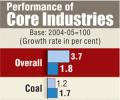
It hit more than a year's low of 1.8 per cent.
India's industry sector grew by 6.7 per cent in July 2005 compared to 8.5 per cent in the same month a year ago.

The eight core industries -- fertilisers, cement, steel, electricity, crude oil, coal, petroleum refinery products and natural gas -- have a combined weight of about 38 per cent in the Index of Industrial Production.

Indian IT service providers face heightened competition from AI-native firms in the next three years, potentially eroding their revenue base unless they remain competitive and protect recurring businesses, according to a report by S&P Global Ratings.

During April-September, the eight sectors grew by 4 per cent, against 5 per cent in the year-ago period.

Growth in output of coal, cement and electricity slowed to 0.3%.

'Investors shouldn't let fear dictate their decisions. The most important step is simply to begin investing.'

S&P Global Ratings warns that a sustained rise in crude oil prices to $130 per barrel could significantly slow India's economic growth, weaken fiscal metrics, and strain corporate and banking sector performance, potentially reducing growth by up to 80 basis points.

'The volatility in the stock markets since September 2024 has hurt the pace of accretion of new investors.'

Industrial production expanded a provisional 3.4 per cent year-on-year in June.

Indian IT stocks have seen a significant decline of up to 33 per cent year-to-date in 2026, largely due to artificial intelligence (AI) disrupting traditional outsourcing models, leading analysts to predict a challenging FY27 for the sector despite some cushion from rupee depreciation.
The mining sector grew by 4.3 per cent in June as against a dip of 4.6 per a year ago.

Through his commitment to democratic norms, debate, dissent and constitutionalism, Jawaharlal Nehru helped ensure that parliamentary democracy took deep root in independent India. Utkarsh Mishra evaluates Nehru's 17 years as India's first prime minister, examining his role in nation-building, democratic institution-building, economic planning, scientific advancement and foreign policy.

Capital goods output registered a steep decline of 16.5 per cent in June

Sun Pharmaceutical Industries' acquisition of US-based Organon & Co. for $11.75 billion, the largest overseas acquisition by an Indian pharma company, has been met with mixed reactions from brokerages, who see strategic entry into women's health and biosimilars but also flag potential integration challenges and debt concerns.
India's eight key infrastructure sectors' output stood at 3 per cent in September, slower than the 6.5 per cent expansion recorded in August, according to official data released on Tuesday. The core sectors' output growth was 2.4 per cent in September last year.

According to the commerce and industry ministry data, during April-February 2018-19, the eight sectors recorded a flat growth rate of 4.3 per cent over the same period previous fiscal.

The manufacturing sector, which accounts for over 75 per cent of the total weight of the index, grew by just 5.6 per cent in May.

Wipro reported Q4FY26 IT services revenue of $2.6 billion, a modest 0.2 per cent Q-o-Q constant currency growth, with adjusted operating profit margin beating estimates at 17.2 per cent. The company announced a significant share buyback of ~15,000 crore, but faces near-term growth challenges, particularly in the BFSI segment, and has issued a soft Q1FY27 revenue guidance.
